
The Breed Standard
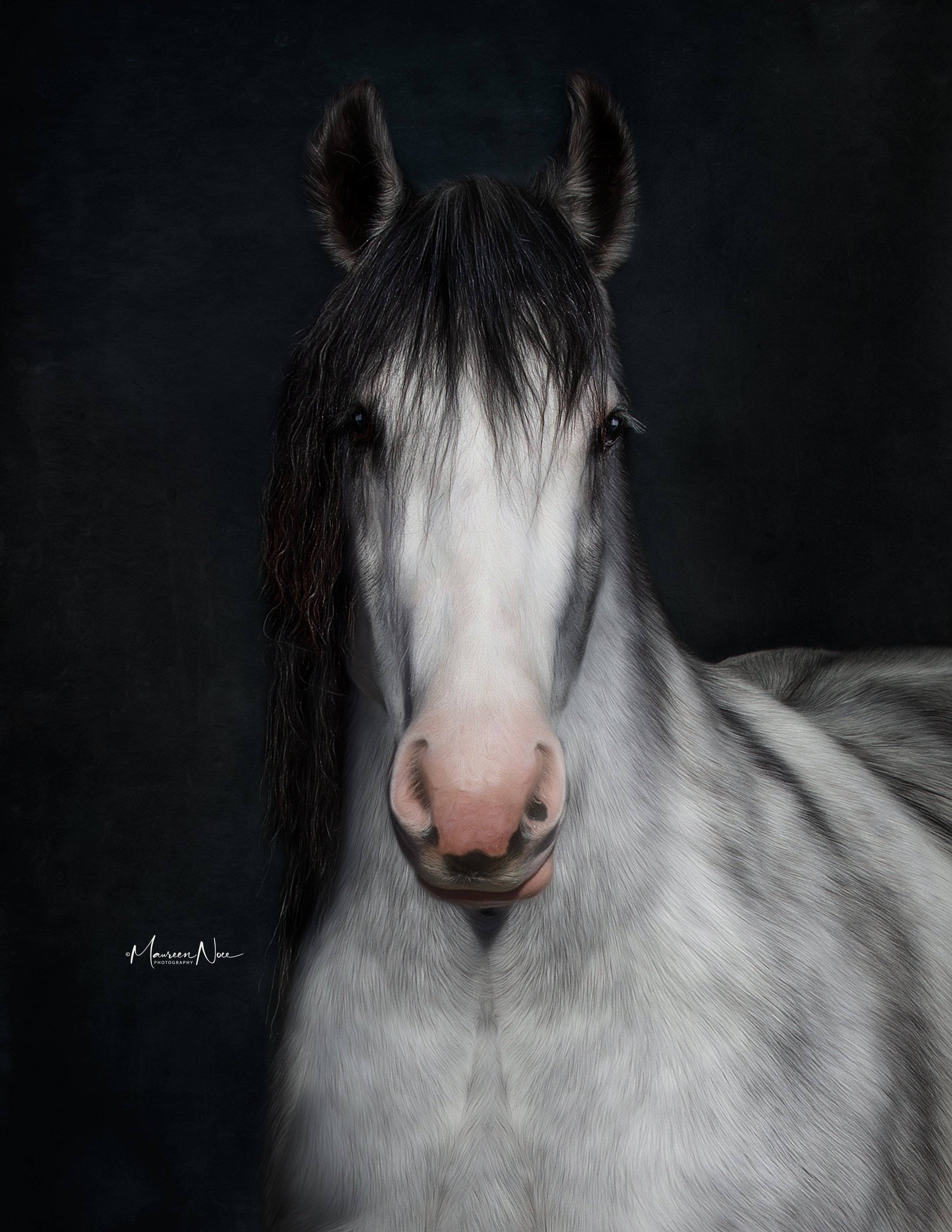
The ideal Gypsy Vanner should resemble a smaller Shire, with more feather and a sweeter, more refined head.
A short back in proportion to the overall body
A broad chest
Heavy, well-rounded hindquarters
Substantial, flat bone (flat through the knee) with wide, strong hooves
Hair: Abundant feather beginning at the knees in front and at or near the hocks behind, flowing down over the front of the hooves. Mane and tail should be full and plentiful. The ideal hair is straight and silky.
Head & Neck: A “sweet” head with a strong neck, in harmony with the horse’s overall appearance. A sweet head is more refined than that of a Shire.
Disposition: The horse should display intelligence, kindness, and a calm, willing temperament.

Photo by Linda Lester Photography
FEATHER
Feather in horses traces back to an ancient, sure-footed, heavily haired type known as the Forest Horse. Feathering is a recessive trait and is additive in nature, meaning it accumulates through selective breeding. British Romani breeders sought to develop a horse with increasingly abundant feather by breeding intentionally from animals that carried this characteristic. This suggests that feather is closely linked to the genetic foundation of the Vanner’s calm, untroubled temperament. When breeding toward less hair, the result over generations is not only reduced feather, but often a gradual loss of the steady, desirable disposition that defines the breed.
COLOR
Contrary to being a color breed, the Gypsy Vanner is defined by body type. Any color is accepted, provided the defining characteristics of the Vanner standard are present. The pursuit of exotic color patterns often requires moving away from the breed’s primary genetic foundation through outcrossing, which can lead to a reduction in essential traits such as heavier bone, correct feather, and the refined head type.
SIZE
Historically, the Gypsy Vanner has been recognized in three size classifications:
Mini: 13.3 hands or under
Classic: 13.2 to 15 hands
Grand: 15.1 hands or over
While the Classic Vanner remains the central type, a smaller version — the Mini Vanner — has gained popularity among British Romani breeders over the past two decades.
Regardless of size, the preservation of the breed depends on maintaining the defining characteristics described within the breed standard.

-
The Gypsy Vanner — often called simply the “Gypsy” or “Vanner” in America — is a rare and unmistakable horse born of the British Isles, shaped within the Romani Traveller communities of Great Britain. Recognized instantly by its compact strength, flowing mane and tail, and abundant feather, the Vanner carries an elegance that is inseparable from its purpose and origin.
These horses were not created by accident, nor by fashion. They were developed over decades with extraordinary care to pull the brightly painted caravans of traveling families — a horse strong enough for work, gentle enough for children, and steady enough to live within the rhythm of daily life.
Renowned for their calm temperament, willingness, and versatility, Gypsy Vanners remain today what they were always meant to be: powerful yet kind, striking yet dependable — a true family horse, and a living legacy of the culture that created them.
-
Although deeply valued and celebrated throughout Great Britain and within Romani Traveller communities for decades after the Second World War, it was not until 1996 that the first selectively bred Gypsy Vanner horses were introduced to North America by Dennis and Cindy Thompson.
Because of the breed’s relatively recent global rise — and its very recent introduction to Colombia — the Gypsy Vanner remains rare. It is also among the first breeds to be formally introduced and widely marketed in the internet era, a circumstance that has inevitably given rise to widespread misconceptions and misinformation surrounding its true origin, type, and standard.
-
Just as a person has a birth certificate, a Gypsy Vanner horse may be registered with the GVHS. Registration, however, does not in itself guarantee superior breeding or quality. It simply confirms that the horse was born to the parents listed on its papers.
More importantly, there should be a documented lineage tracing back — whether through a few generations or many — to the horses that inspired and established the breed.
When only one or two generations appear on a pedigree, it is reasonable to ask why. The breed has now been registered for nearly three decades, with DNA records maintained back to the earliest foundation horses. In most cases, a horse today should reflect a deeper recorded heritage.
There can be legitimate explanations — such as the loss of older DNA records before testing became standard — but in some instances, limited pedigree depth may indicate that the horse’s heritage cannot be verified beyond its immediate parents.
Such a horse may still be beautiful and valuable in its own right. However, without documented heritage, it cannot be assured of meeting the foundational type and defining standards that characterize the breed, and consequently may not be apt to perform the duties for which its creators intended.
-
The GVHS strictly prohibits crossbreeding for clear technical reasons. The Romani and Traveller families who created the Gypsy Vanner likewise reject outcrossing on principle, as the breed was developed with a singular and intentional purpose.
While some may view random crosses as a way to produce something “unique,” the Gypsy Vanner was never the result of chance. It was shaped through generations of selective breeding toward a very specific ideal: the horse we recognize and value today.
The moment outcrossing occurs, much of what makes the breed extraordinary begins to erode — temperament, soundness, health, and the functional ability to perform the work for which it was created.
Crossbred horses may be visually attractive, but they often lack the balance and structure required of the true Vanner. Many would struggle to work correctly in harness due to exaggerated necks, improper hindquarter angles, or lighter, less durable build.
In addition, horses bred outside of verified heritage programs may carry limited or unverifiable lineage beyond one or two generations. This does not make them without worth — but it does mean their connection to the foundational breed type cannot be assured.
When a horse shows only minimal recorded heritage in a breed with decades of DNA-supported documentation, it is reasonable to ask why. Transparency and verification remain essential to protecting the integrity of the Gypsy Vanner.
-
In principle, each of these names refers to the same breed, with variations in terminology shaped by geography, tradition, origin, and circumstance. What distinguishes the Vanner, however, is the emphasis on correct conformation and adherence to the seven defining standards of the breed.
This focus also serves to differentiate selectively bred Vanners from the broader population of horses produced indiscriminately for general markets. Many such horses were never intended to preserve breed type or character.
While the Gypsy Vanner may be referred to by different names around the world, what matters most is fidelity to the breed standard and to the values established first by the Romani families who spent decades shaping a unique vision — creating a horse suited to the needs of their way of life — and later by the registries developed in recognition of that work.
This includes breeding in accordance with accepted standards, supported whenever possible by DNA verification and documentation to ensure authenticity and quality. The GVHS was the first such registry and remains the largest today.
-
Claims of quality based solely on origin are often driven more by sentiment than by discernment. The same applies to horses promoted as superior simply because they were purchased “directly” from Gypsies.
Birthplace alone does not guarantee excellence. Just as being born in Italy does not automatically make one a master of pasta, a horse born in the British Isles — or bred by someone within a traveling community — does not inherently possess the defining qualities of a true Gypsy Vanner.
For decades, serious British breeding families developed this horse with discipline and pride, guided by a clear and consistent vision. The result was a distinctive type — strong, beautiful, intelligent, and kind. Historically, only a small percentage of horses met that standard. Many others were bred without selectivity for broader commercial markets.
Today, there are thousands of selectively bred, DNA-verified horses worldwide that embody the characteristics that made the Gypsy Vanner admired in the first place. When such verified examples exist, it is reasonable to ask why one would rely solely on geography as proof of quality.
To purchase a horse of uncertain heritage and expect it to fulfill the defining traits of the breed is akin to placing a luxury emblem on an ordinary vehicle. It may convince the untrained eye — but the true structure, substance, and engineering beneath the surface cannot be manufactured.
In the end, the question is not where a horse was found.
It is whether it carries the genetics, type, and temperament that will endure. -
Terms such as “purebred” or “pure blood” carry little objective meaning on their own. No respected breed registry relies on such umbrella language, because it is unverifiable and lacks technical definition. While these phrases suggest that a horse has never been crossed at any point in its history, registration alone does not guarantee quality, depth of lineage, or adherence to true breed type.
The only reliable standard is documentation: DNA verification within the official registry, confirmed parentage, and a pedigree that traces back to the foundational horses of the breed. Without this, what is being purchased is often a marketed horse — not a preserved lineage.
Indiscriminate crossbreeding, strictly prohibited by the GVHS, dilutes the genetic foundation of the Vanner and erodes the inherited traits that define its temperament, structure, and purpose. After decades of selective breeding supported by DNA records, there is little reason to rely on horses without verifiable heritage. Preservation requires evidence, discipline, and transparency — not terminology.
-
In most cases, the answer lies in outcrossing at some point within the lineage. Feathered horses trace back to ancient cold-blooded types often referred to as the Forest Horse — animals historically associated with heavier bone and calmer dispositions. Feather itself is a recessive and cumulative trait. When a heavily feathered horse is crossed with a smooth-legged type, subsequent generations typically show reduced feather and lighter substance.
Maintaining abundant feather requires intentional breeding from horses that consistently express the trait. When those characteristics are gradually bred away, other defining qualities of the Gypsy Vanner — structure, substance, and temperament — may also begin to diminish. Over time, the horse may still resemble a Vanner, but the essence that made the breed distinctive can quietly erode.
-
Although the Gypsy Vanner was historically developed as a caravan horse, today it is remarkably versatile and can excel in a variety of equestrian disciplines.
Some of the most common roles for the Gypsy Vanner include:
Companion Horses
Gypsy Vanners are known for their kind and affectionate nature, making them exceptional companions. They often form deep bonds with their owners and are valued as family horses as much as working partners.
Driving
The breed’s strength, substance, and calm temperament make it ideally suited for driving. Gypsy Vanners pull carriages and carts with elegance, and their distinctive presence is often showcased in parades and public exhibitions.
Equine-Assisted Therapy
Their patient, steady disposition makes Gypsy Vanners excellent candidates for equine-assisted therapy programs. Their gentle nature can have a meaningful impact on individuals participating in therapeutic activities.
Showing and Sport
Gypsy Vanners are highly admired in the show ring, where their flowing manes, abundant feather, and balanced temperament draw attention. They compete in halter, driving, dressage, and other disciplines that highlight both beauty and willingness.
Respecting the Breed’s Purpose
The Gypsy Vanner is a cold-blood heritage horse: steady, powerful, and deeply people-oriented. While versatile and eager to please, the breed was not designed for the extreme speed, hyper-reactivity, or highly artificial movement demanded in certain specialized gaited or hot-blood performance disciplines.
When the Vanner is pushed into unnatural exhibition for spectacle rather than suitability, it risks diminishing both the horse’s welfare and the cultural purpose for which the breed was created.
True appreciation of the Gypsy Vanner means honoring what it was always meant to be: a noble, capable, gentle horse of strength, substance, and enduring temperament.
-
As a formally registered breed, the Gypsy Vanner may appear relatively recent. In truth, however, it has been treasured for decades as a valued member of British Romani families.
In recognition of this heritage, Dennis and Cindy Thompson — along with the GVHS — encouraged what they referred to as the principle of parallel value. The idea was simple: a quality horse exchanged within the Romani community should retain its equivalent value when exported, accounting for transportation and import costs, rather than being artificially inflated or diminished in a new market.
For example, a horse valued at the equivalent of $20,000 in England, with $5,000 in shipping and $1,000 in import costs, would reasonably enter the American market at approximately $26,000. This approach honors the value originally placed upon the horse by its creators and preserves respect for the breed’s cultural foundation — particularly when the animal presents verified type, temperament, and DNA.
Differences in market value often reflect one essential distinction: a horse of unknown or commercial heritage versus a horse of documented lineage bred to consistently reproduce a defined type — a breed.
Today, quality Gypsy Vanners with verified DNA and established heritage typically range between $15,000 and $50,000, with exceptional individuals — particularly breeding stallions and mares of significant lineage — commanding substantially higher prices, sometimes well into six figures.

“Gypsy gold does not chink and glitter… it neighs in the dark and gleams in the sunlight.”
-Old Gypsy Proverb