Dietary Needs and Deficiencies of The Gypsy Vanner in Colombia
Technical and Physiological Analysis of Nutrition, Health, and Reproduction of the Gypsy Vanner Horse in Rionegro, Antioquia
The Gypsy Vanner horse, also known as the Irish Cob or Traditional Gypsy Cob, represents an equine phenotype of high heritage and biological value. It is characterized by its robustness, docile temperament, and a distinctive morphology that includes a profuse mane, tail, and the characteristic long hair on the lower legs known as "feathering."
The introduction and maintenance of this breed in the Eastern Antioquian Highlands, specifically in the municipality of Rionegro, poses highly complex technical challenges for farm managers and veterinarians. The environment of Rionegro—situated at an average altitude of 2,130 meters above sea level—is characterized by volcanic soils and a forage supply dominated by Kikuyu grass (Cenchrus clandestinus). These factors interact critically with the genetic and metabolic predispositions inherent to the Gypsy Vanner.
This report details the nutritional requirements, environmental deficiencies, and reproductive management strategies necessary to optimize the health of these specimens and their miniature variants within the specific context of Antioquia.
Genetic Determinants and Breed Pathophysiology
The historical selection of the Gypsy Vanner as a light draft and transport horse for nomadic communities in the British Isles has consolidated an extremely efficient metabolism. Technically, these animals are classified as "easy keepers," meaning they possess a superior ability to extract and store energy from forages that would be considered low-quality for other breeds. However, in a modern domestication setting with access to improved pastures and concentrated supplements, this efficiency becomes a risk factor for severe metabolic disorders.
Polysaccharide Storage Myopathy (PSSM Type 1)
The most critical health risk for the Gypsy Vanner population is Type 1 Polysaccharide Storage Myopathy (PSSM1). This condition is caused by an autosomal dominant mutation in the $GYS1$ gene, which encodes the muscle glycogen synthase enzyme. In affected horses, the enzyme remains constantly active, causing muscle cells to abnormally produce and accumulate glycogen along with an amylase-resistant polysaccharide that cannot be used as an energy substrate during exercise.
The prevalence of PSSM1 in Gypsy Vanners is notably high. Statistics indicate that approximately 21.12% of the population is heterozygous ($n/PSSM1$) and 1.44% is homozygous ($PSSM1/PSSM1$) for this mutation. Clinically, this manifests as episodes of "tying-up," muscle stiffness, tremors, excessive sweating, and reluctance to move. Dietary management is the cornerstone of treatment, as insulin secreted after the ingestion of starches and sugars further stimulates the defective glycogen synthase, worsening the accumulation.
Foal Immunodeficiency Syndrome (FIS)
Another lethal genetic concern is Foal Immunodeficiency Syndrome (FIS), formerly known as Fell Pony Immunodeficiency Syndrome. This condition affects the development of the immune system—specifically the production of B-lymphocytes and antibodies—as well as erythropoiesis (red blood cell production).
Foals with FIS are born appearing normal due to temporary protection from maternal colostrum antibodies. However, once these levels decline, the foals are unable to generate their own immune response, generally succumbing to secondary infections and severe anemia before four months of age. DNA testing to identify carriers is mandatory for any responsible breeding program in the region to avoid mating two carrier individuals.
Chronic Progressive Lymphedema (CPL) and Dermatological Health
Gypsy Vanners are highly susceptible to Chronic Progressive Lymphedema (CPL), a degenerative disease of the lymphatic system affecting the lower limbs. This pathology is characterized by lymphatic drainage failure, causing chronic swelling, subcutaneous tissue fibrosis, and the formation of nodules and skin folds on the legs. The profuse feathering, while aesthetically desirable, creates a microclimate that traps moisture, mud, and debris, facilitating the proliferation of bacteria and fungi that cause persistent dermatitis, colloquially known as "scratches" or "greasy heel."
DisorderGenetic/Mechanical BasisPrimary Clinical SignsImplication in RionegroPSSM1$GYS1$ Mutation (Dominant)Stiffness, muscle pain, exercise intoleranceHigh risk with young Kikuyu grass (high NSC)FISRecessive breed-linkedImmunodeficiency, anemia, death < 4 monthsRequires genetic testing of breeding stockCPLLymphatic system failureSwelling, fibrosis, leg infectionsAggravated by Antioquia's environmental humidityEMSInsulin resistanceObesity, fat deposits, laminitisCommon in "easy keepers" on high-grain diets
The Nutritional Environment of Rionegro: Soils and Forage
Nutrition in Eastern Antioquia is intrinsically linked to soil composition and the physiology of Kikuyu grass, which forms the forage base for nearly all equine operations in Rionegro.
Andean Soil Chemistry and Mineral Availability
The soils of Rionegro are predominantly Andisols, developed from volcanic ash. These soils typically have an acidic pH (4.5 to 5.5) and a high phosphorus-fixing capacity due to minerals like allophane and iron/aluminum sesquioxides. This means that even if the soil contains phosphorus, it is chemically "locked" and not efficiently absorbed by plants, resulting in forages with low levels of this essential mineral for energy metabolism and bone integrity.
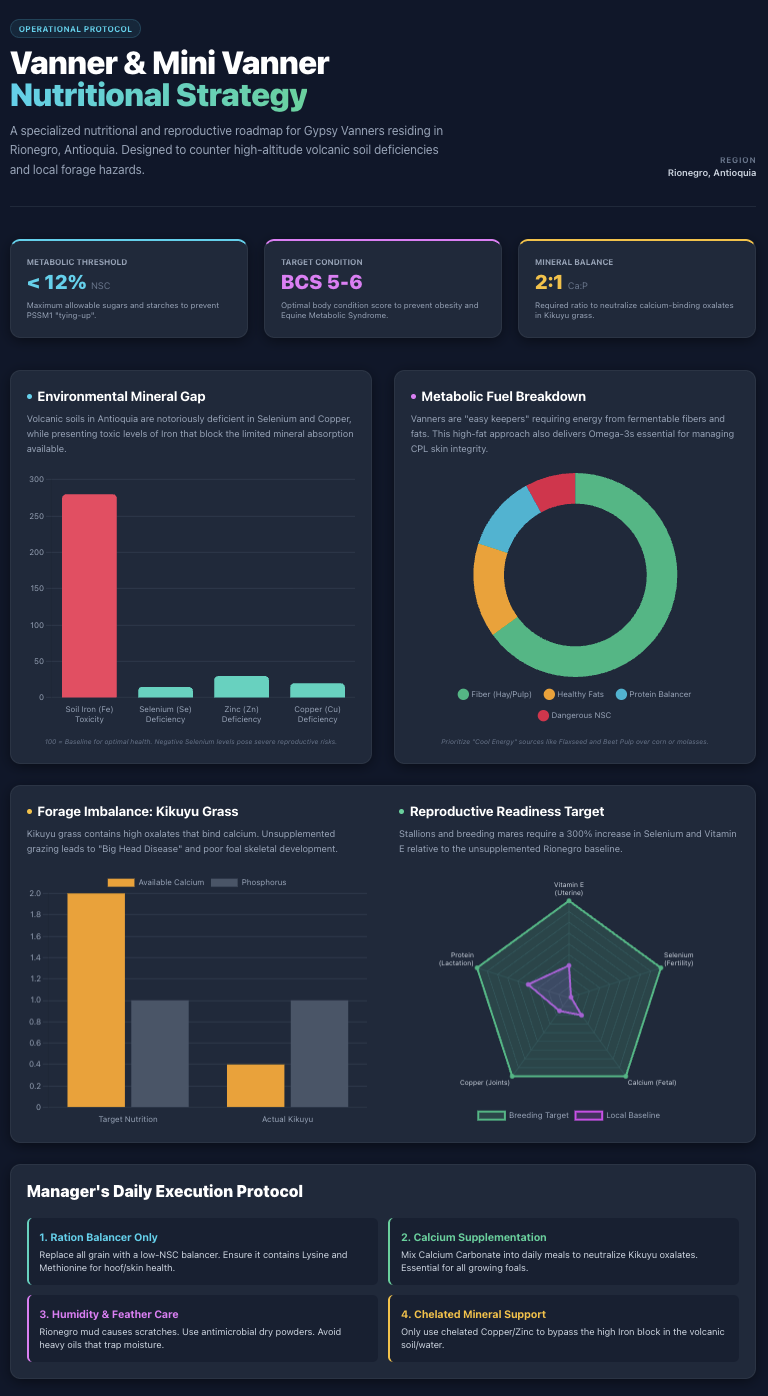
Furthermore, there is a generalized deficiency of selenium, zinc, and copper in the region's pastures. These minerals are vital for the antioxidant system, hoof health, and cartilage development. High iron levels in the water or soil, common in parts of Antioquia, can interfere with copper absorption, exacerbating subclinical deficiencies that affect coat color and connective tissue strength.
Kikuyu Grass and Calcium Sequestration by Oxalates
The greatest nutritional challenge in Rionegro for the Gypsy Vanner is the oxalic acid content in Kikuyu grass. This grass accumulates oxalates that bind to calcium in the horse's digestive tract to form calcium oxalate crystals. Unlike ruminants, horses lack the bacteria (like Oxalobacter formigenes) capable of degrading these crystals, meaning they cannot utilize the calcium bound to the oxalate.
This induces a deficiency of bioavailable calcium, forcing the horse's body to extract calcium from its own bones to maintain blood serum levels—a process mediated by the parathyroid hormone. The result is Nutritional Secondary Hyperparathyroidism, a metabolic bone disease that causes skeletal weakening and, in severe cases, facial bone deformation (leontiasis ossea or "big head"). For a heavy-boned breed like the Gypsy Vanner, this loss of mineral density is catastrophic and can lead to chronic lameness and pathological fractures.
Nutritional ParameterTypical Kikuyu Value (Antioquia)Vanner Requirement (Maintenance)Technical ImplicationCrude Protein17.0% - 22.0%8.0% - 12.0%Excess nitrogen; requires energy for excretionDigestible Energy1.07 - 1.15 Mcal/kg DM16.7 - 20.0 Mcal/dayLow energy density for workTotal Oxalates24.4 g/kg DM< 5.0 g/kg DM (Ideal)Massive calcium sequestrationTotal Calcium0.25% - 0.38%0.3% - 0.5%Insufficient in the presence of oxalatesTotal Phosphorus0.18% - 0.33%0.2% - 0.3%Ca:P ratio often inverts during absorption
Reproductive Physiology in High-Altitude Tropics
Reproduction in Rionegro is influenced by nutrition, the physiological effects of altitude, and the lack of marked photoperiodic seasonality in Colombia.
Hypoxia and Corpus Luteum Efficiency
Rionegro’s altitude implies lower partial pressure of oxygen, generating a state of relative hypoxia. Research in domestic species at similar altitudes suggests that hypoxia can induce cellular oxidative stress, affecting the hypothalamus-pituitary-gonadal axis. In mares, this can lead to luteal dysfunction, where the corpus luteum fails to produce sufficient progesterone to maintain early pregnancy. The use of specific antioxidants like Selenium and Vitamin E has been shown to improve embryo viability in high-mountain environments.
Postpartum Management and Neonatal Health
In Colombia, mares may cycle year-round. However, a high incidence of placentitis (73% of pathologies in pregnant mares at Colombian referral centers) has been observed, requiring strict ultrasound monitoring of the combined thickness of the uterus and placenta (CTUP) in the final trimester.
In newborns, Neonatal Maladjustment Syndrome (perinatal asphyxia) is the most frequent pathology (39% of cases), possibly exacerbated by hypoxic factors during birth. The pregnant mare's nutrition must guarantee optimal copper and zinc levels to prevent Developmental Orthopedic Diseases (DOD) in the foal, which are especially prevalent in fast-growing heavy breeds.
Dietary Program Design for Vanners and Mini Vanners
An effective nutritional program in Antioquia must simultaneously address carbohydrate restriction for PSSM1 and the correction of the mineral imbalance caused by Kikuyu grass.
Strategy for PSSM1 Horses
For PSSM1 specimens, the goal is to reduce the insulin response. This is achieved by keeping Non-Structural Carbohydrates (NSC)—the sum of starch and simple sugars—below 12% of the total dry matter intake. Since Kikuyu grass is relatively low in NSC but also low in digestible energy, caloric supplementation should come from fats and highly fermentable fibers.
The use of vegetable oils (especially rice bran oil for its gamma-oryzanol content) provides a source of "cool energy" that improves muscle performance without affecting blood glucose. A Gypsy Vanner in moderate work in Rionegro may require between 300 ml and 500 ml of oil daily, introduced gradually.
Correcting the Calcium-Phosphorus Balance ($Ca:P$)
Due to calcium sequestration by Kikuyu oxalates, mineral supplementation must not be generic. A supplement providing free calcium (calcium carbonate or calcium gluconate) is required. The $Ca:P$ ratio in the supplement should be high, ideally $2:1$ or even $3:1$, to ensure the final ratio in the total diet does not fall below $1.5:1$ after the oxalate effect.
Specific Nutrition for the Mini Vanner
Mini Vanners face a high risk of obesity and laminitis because their caloric requirements are minimal compared to their appetite. Calculating body weight in miniatures is a technical challenge; standard weight tapes are inaccurate. The specific formula for miniature horses should be used:
$$Weight (kg) = \frac{(9.36 \times \text{Heart Girth cm}) + (5 \times \text{Body Length cm}) - 348.5}{2.2}$$
For a 150 kg Mini Vanner, high-quality hay should be limited to 1.5% of body weight, and concentrates should be replaced with a "ration balancer." This provides necessary minerals and vitamins in a small dose (approx. 100-200 g/day) without the excess calories that cause Equine Metabolic Syndrome (EMS).
Analysis of Local Market Supplies in Colombia
Recommended Concentrates and Fiber
Solla Line: Fortín Fibra is a valuable option as it uses digestible fiber sources to complement average-quality pastures while minimizing starch load. Campeón Plata is also notable for its energy derived primarily from fat and fiber.
Italcol Line: Caballos de Fuerza is designed with a balance of organic minerals and oil levels that favor body condition and coat shine. For lactating mares, Brio Yeguas provides necessary protein support but must be dosed carefully.
Finca Line: Cinta Azul Alfalfa Cubes are an excellent tool in Rionegro to increase natural calcium intake and high-quality protein, partially counteracting the Kikuyu oxalates.
Specialized Mineral and Vitamin Supplementation
Equisure CalciHorse: Critical for correcting calcium deficiencies; includes Vitamins A and D3, essential for mineral absorption at high altitudes.
Equiforma Sel-e-cal: Combines Selenium, Vitamin E, and Calcium, addressing the three main regional deficiencies: calcium sequestration, soil selenium deficiency, and the need for antioxidant support for PSSM1 horses.
Red Cell / Perktone: Rich in iron, copper, and B-complex. While iron deficiency is rare, the copper and cobalt supply is fundamental for vascular integrity and hemoglobin synthesis for oxygen transport at altitude.
Management Recommendations for the Farm Manager
Grazing Management: Kikuyu quality varies with rain. After dry spells followed by heavy rain, tender Kikuyu can accumulate dangerous levels of nitrates and sugars. Restrict grazing during early morning hours when NSC levels are highest, or use grazing muzzles.
Exercise Protocol: Consistent exercise is mandatory. Daily physical activity, even at low intensity (20-minute walks), improves insulin sensitivity. Avoid "weekend warrior" syndrome (stabling all week followed by intense work), as this triggers muscle crises.
Leg Care: Given Antioquia's humidity, feather care must be meticulous. Keep stalls dry (using treated wood shavings), dry the legs completely after washing, and perform regular manual inspections under the hair for scabs or heat.
Technical Conclusions
Breeding Gypsy Vanners and Mini Vanners in Rionegro, Antioquia, requires a paradigm shift from traditional Colombian equine nutrition. A Vanner cannot be fed like a Colombian Paso Fino due to profound differences in metabolic efficiency and genetic predispositions.
Correcting the mineral balance to mitigate Kikuyu oxalates, combined with a low-starch, high-fat diet, is essential to prevent skeletal disease and PSSM1 crises. Furthermore, antioxidant support is the key to overcoming the reproductive challenges of the Andean altitude.